


Jump to Section:
General Recommendations
These recommendations are meant to increase the maximum effectiveness of Texas State’s social media accounts and encourage a consistent, flexible style.
The university’s Editorial Style Guide will also be useful when writing for social media, as will our social media brand guidelines.
FREQUENCY OF POSTS
Facebook: At least 3 times a week. No more than 3 posts per day.
Twitter: At least once a day, not including replies. Space posts out by at least 30 minutes.
Instagram: At least once a week. For maximum engagement, posting at least every 2-3 days is recommended. Do not post more than 2 times per day on your Instagram feed, instead utilize Instagram Stories for extra posts. If you have multiple photos you want to share, take advantage of Instagram's carousels, which allow you to post up to 10 photos and videos at one time.
DON'T SPAM
Don't post repetitive content frequently.
MOBILE POSTS
Be careful when posting from your phone in order to avoid typos. Always take an extra moment to look over your post again. Whenever possible, get someone else to review your post before sending it.
QR CODES AND URL SHORTENERS
Do not post QR codes on social media. QR codes are not effective online. Use links instead. While using a URL shortener will not give you more characters on a Twitter post, it transforms long links into shorter, more manageable ones.
ITAC provides a free resource to create a vanity/short URL for txstate.edu sites.
VISUALS
The use of photos and videos are highly encouraged to increase engagement and share-ability. Posts with only copy will not reach as many people because there is nothing to catch their eye with.
Images and videos used on social media should follow accessibility best practices. When text is used on a graphic, limit the amount of copy and use color combinations that meet color contrast requirements. Alt text should be added to images whenever possible. Videos should have captions.
EVENTS
Events can be covered in a number of different ways. If you are focusing on increasing attendance and participation, promoting your event ahead of time is encouraged.
Talking about events as they happen makes your account more engaging and enriches your content. Some suggestions for covering live events include streaming your event live via Facebook LIVE, Instagram LIVE, or YouTube LIVE. Live videos can consist of a stationary camera or they can incorporate a moving camera with a directorial strategy that tells a story by showing the audience what you want them to see or by verbally explaining to them what they are seeing.
Whichever strategy you use for live videos, keep your audience engaged by continuing to provide purposeful content.
If you are interested in covering an event live but want to have more control over what is being captured, Snapchat and Instagram Stories are excellent tools.
Collect high-quality photos during your event so you can post those photos live or at a later time. Talking about events afterward helps increase brand awareness and is an alternative to posting live if you are unable post while the event is ongoing or you need more information to make your post more impactful.
Monitoring and Responding to Comments
TXST Office of Emergency Management (@TXStateOoEM)
City of San Marcos (@CityofSanMarcos)
If there is a situation involving a specific building such as Alkek Library (@alkeklibrary), retweeting information from their account about closures or notices is encouraged.
Crisis Communication
Be aware of major news stories and current events that may affect your social media posts. Always review what you have scheduled and delete scheduled posts and ads when a crisis or emergency directly impacts our campuses or communities.
In case of an on-campus emergency, important safety information will be shared via the President’s Office, University Communications, and/or OEM/UPD. These messages will always go out on our main TXST social accounts first along with appropriate email/text communications.
When unsure about posting, WAIT for messaging from the main TXST social accounts and reshare accordingly. Unique links, graphics, and formatted graphics will be sent with messaging.
Reliable sources include:
- Texas State UPD (@TxStateUPD)
- Texas State University (@txst)
- Transportation Services (@TXST_Transport)
- TXST Office of Emergency Management (@TXStateOoEM)
- City of San Marcos (@CityofSanMarcos)
If there is a situation involving a specific building such as Alkek Library (@alkeklibrary), retweeting information from their account about closures or notices is encouraged.
Cross Posting vs. Cross Promotion
Cross-posting is posting the same content on every social media channel and is not encouraged. Cross-promotion means crafting a unique message for each channel to better connect with each user base.
Tips for optimizing your content:
- Use a different photo asset with platform-specific dimensions.
- Stagger your posts so that you aren't posting the same content in the same hour. If possible, stagger your content so that your Twitter post runs on one day and your Facebook post runs on another.
- Not all content needs to be shared on every network. Consider your audience and how fast you want them to see your message.
Facebook Best Practices
Facebook is a platform that lets you connect with current students, prospective students, parents, and alumni plus industry thought leaders in your expertise area.
All Editorial Style Guide rules apply when posting on Facebook. Please review UPPS 06.05.05 for all social media policies, including account access and setup.
Top 5 Best Practices
- Come up with a consistent content calendar and publishing frequency.
- Emphasize education throughout your Facebook content.
- Prioritize positive, proactive content over clickbait.
- Engage your followers without forcing them to leave Facebook.
- Regularly assess your Facebook performance via analytics.
Sprout Social has some great tips on how to use Facebook to your brand’s advantage.
Best Practices for Photos and Graphics
Images with text should use color combinations that meet color contrast requirements. Alt text should be added to images on Facebook whenever possible.
The Algorithm
There is no character limit, but you’re encouraged to keep posts short. Keep in mind that not everyone will see your posts in a timely manner due to Facebook's algorithm.
This algorithm favors:
- Images that do not contain text
- Videos with captions
- Live videos
- Sharing and tagging other pages
Features
Facebook Business Suite. We recommend setting up a Business Suite account in order to better manage safety settings and access to pages. This also allows you to view your Facebook page's analytics, which is mentioned in further detail at the bottom of the page.
Page Moderation/Profanity Filter. This helps keep spam or hate comments filtered out from appearing on posts, even if they are published. This means that people won't be able to see these comments left on the post publicly, but you will be able to see that the comment was left on the post. To ensure that these kinds of comments are filtered out, make sure the filter is set to HIGH.
Facebook Stories. Similar to Instagram Stories, these allow you to post a variety of content for a 24-hour period of time. These allow you to get access to parts of your audience that might not be reached with physical posts due to the algorithm.
Cover Images and Avatars
When creating avatars for social media, we recommend using the following guidelines and templates to help your page present a recognizable TXST identity and voice of authority.
Avatar guidelines:
- Use the avatar to clearly identify your unit as the owner of the page.
- Use expressive photos or illustrations for cover images or headers.
- Use the acronym “TXST” and the name of your unit in bold. If your unit name is too long for the avatar for legibility please use the appropriate abbreviation. (Your full name must be present in your account name or bio.)
- Maroon backgrounds are reserved for the main TXST social media channels.
- Please do not use a TXST logo or University Seal in your avatar. The TXST logo is reserved for the main TXST social media channels. The SuperCat logo is reserved for Athletics social media channels and permission to utilize that logo must be requested through Athletics.
If you have a uniquely designed logo approved by the University Marketing (ex. McCoy College of Business) you may opt out of the system avatars. For more details on institutional logos and brand assets please review our Logos and Guidelines.
Link Posts
When posting a link, delete the text of the URL from your post after the preview appears. Your link will remain in the preview but won't clutter up the text of your post. There are certain situations that cause the link preview to not populate. In this situation, we recommend leaving the link in the caption, removing the link preview section, and providing or uploading a clean image that relates to your brand and the post's content in the appropriate size. For an example of this, please look below:
You can read more about creating Facebook link previews on MeetEdgar's blog.
Analytics
Insights in Facebook Business Suite help you understand the results of your organic and paid social media efforts across Facebook and Instagram in one place. With Insights, you can see metrics, trends, and visual reports that can make it easier to understand which Facebook Page and Instagram strategies work well and where to make improvements. You can then optimize the way you spend your time and resources.
Instagram Best Practices
Instagram is great for visually showing your audience what your brand is about. There are many strategies that work on this platform. Some strategies include only sharing photos with no text, incorporating your school colors, and reposting photos from other accounts.
The @txst Instagram has adopted the strategy of only using high-quality photos and videos with minimal (light leak treatment only) to no filters. Our strategy also includes showcasing a mix of abstract architecture, close-ups of student life and photos showcasing the campus grounds.
There are no character limits on Instagram, but brevity is encouraged. Follow the Editorial Style Guide when writing posts. Please review UPPS 06.05.05 for all social media policies, including account access and setup. Because Instagram is a highly visual platform, it is especially important that all images posted meet accessibility standards. Images with text should use color combinations that meet color contrast requirements. Alt text should be added to images on Instagram whenever possible.
Features
Instagram Live — Add guests to livestreams
Instagram Stories and Highlights
Instagram Story Link Stickers - open to all accounts now
Avatars
When creating avatars for social media, we recommend using the following guidelines and templates to help your page present a recognizable TXST identity and voice of authority.
Avatar guidelines:
- Use the avatar to clearly identify your unit as the owner of the page.
- Use expressive photos or illustrations for cover images or headers.
- Use the acronym “TXST” and the name of your unit in bold. If your unit name is too long for the avatar for legibility please use the appropriate abbreviation. (Your full name must be present in your account name or bio.)
- Maroon backgrounds are reserved for the main TXST social media channels.
- Please do not use a TXST logo or University Seal in your avatar. The TXST logo is reserved for the main TXST social media channels. The SuperCat logo is reserved for Athletics social media channels and permission to utilize that logo must be requested through Athletics.
Hashtags
Hashtags are meant to group similar photos into categories so they are easily searchable. Incorporating a few popular hashtags in your post is encouraged. If you have more than a few, you can comment on your own photo to add more hashtags. Only focus on relevant and popular hashtags. Before using a trending hashtag, make sure you understand how the hashtag is being used and if Instagram posts using that hashtag are appropriate for your audience.
Use approved hashtags. Using the correct hashtags will maximize the reach and effectiveness of your Instagram post.
When creating a hashtag for an event, be sure that it contains a connection to the university.
Links
You can't include clickable links in the captions of normal Instagram feed posts, but that doesn't mean that post captions are useless! You can still use them to get users' attention, share extracts from your content, and extend your reach with carefully selected hashtags.
Our best recommendation is to make your "link in bio" go to the main Texas State website associated with your organization. Learn more about how to share links on Instagram.
Instagram rolled out the official link sticker for Instagram Stories to all accounts starting in October 2021. All university channels are able to share a link within their stories now.
Reposts
If you see a photo you’d like to share, contact the person who posted the photo and ask them for permission to use the photo. Always credit the original user.
Instagram automatically sizes your videos to fit the screen. If you are sharing a video that is wider or taller than the auto fit, press the "Expand" icon (two outward facing arrows) in the bottom left-hand corner of the photo once you've selected it.
When sharing videos on Instagram, keep in mind that you are able to control what the still image will look like. This still image is seen before your video plays and as a square on your profile page. Simply select "Cover" on the bottom right of the "Filter, Trim, Cover" screen to choose what part in the video you want to be displayed first (Cover).
Adding a Location
Instagram Location is a great (and easy) way to make sure you're being found by high-value followers and connected to the larger university community. Every day, thousands of people browse through Instagram location-tagged posts to look for content they like and accounts to follow. Instagram has slowly made their location features more and more powerful over the last year.
Locations on campus:
- Old Main
- LBJ Student Center
- Commons Dining Hall
- Harris Dining Hall
- Jones Dining Center
- Performing Arts Center
- Texas State University San Marcos Campus
- Sewell Park
- Bobcat Stadium, Bobcat Football, Jim Wacker Field
- Strahan Arena
- Texas State University Round Rock Campus
- McCoy College of Business
- Student Recreation Center
- Bobcat Soccer Complex
- Bobcat Ballpark
- Texas State Baseball
- Intramural Sports Fields
- Texas State Track and Field
- Ingram School of Engineering
- Bobcat Village
Giphys and Stickers in Instagram Stories
University Marketing maintains the official university giphy account. You can find the general brand and TXST stickers that can be used on Instagram Stories, TikToks, or download to use in tweets or replies as you need. Stickers/giphys currently include: Boko, graduation, alumni, RRC, and more!
LinkedIn Best Practices
LinkedIn is a great platform to showcase your department or college and its efforts in research, academic accomplishments, recruiting faculty or staff, and more.
Getting Started
Create a Company Page
When you are creating a LinkedIn account for your department, make sure you are creating a company page rather than a personal profile. It has a lot of the same features as a personal profile but includes more sections to add a description of your department's focus and primary audience.
Profile Picture
Use the TXST Brand avatar as your profile picture and include your department or college’s name in it as well.
Website
Link to your department’s homepage so that it is one of the first links a user will see when they visit your company page.
Tagline
Summarize your department’s mission in 120 characters or less. Don’t worry, you’ll be able to add more detail about your department in the description.
Optimize Your Page
Banner Image
Your banner image is important in that it is the largest and first image a user will see when they land on your page. Make sure it is a high resolution photo of campus or your building.
Overview
Lead with relevant terms and phrases that describe your organization’s mission and purpose (LinkedIn members can search by keywords).
Call to Action Buttons
Customize your button to align with your goals and track who’s clicked in the admin view or in visitor analytics. We recommend choosing the button labeled “contact us” for the best results and the most actionable engagement.
Posting on LinkedIn
Content to share
Here are some examples to get you started with your LinkedIn content:
-
TXST News articles related to your program or college
-
News articles about faculty research
-
Videos (if available)
-
Student stories/highlights
-
Program highlights, degrees available, and courses available
-
Rankings (if available)
-
Job placement statistics and careers for your students
-
LinkedIn Polls
How often to post
Posting on LinkedIn should be consistent, just like your other social media platforms. About once or twice a week is ideal.
Engage
Support other TXST pages on LinkedIn by connecting or following other university official pages, liking content, and resharing other news articles related to your college or organization. Having a LinkedIn page also lends itself to engage with thought leaders and faculty in your industry or field of work.
Hashtags
Hashtags on LinkedIn work like hashtags on Instagram and Twitter and keywords on YouTube. Hashtags make you visible to people searching in your field. For example, if you are the engineering department of Texas State, use the hashtags “#engineering,” “#STEM,” “#science,” or “#highered.” All those hashtags would be relevant and helpful to get your audience engaged with your page. LinkedIn also has the built-in feature of recommending hashtags for you to use that are in line with your content. We recommend 3-4 hashtags max per post.
Additional Resources
X (Twitter) Best Practices
Twitter, now known as X, is a great tool for relaying messages in a timely manner because it is made up of tweets displayed in a reverse chronological order in your feed.
Twitter's character limit is 280, but it is still important to be succinct in your messaging.
You’re encouraged to follow the university’s Editorial Style Guide when possible, but Twitter’s character limit means some of these rules are flexible. Refer to our social media style guide for more specific writing guidelines. Please review UPPS 06.05.05 for all social media policies, including account access and setup.
Features
Cover Images and Avatars
When creating avatars for social media, we recommend using the following guidelines and templates to help your page present a recognizable TXST identity and voice of authority.
Avatar guidelines:
- Use the avatar to clearly identify your unit as the owner of the page.
- Use expressive photos or illustrations for cover images or headers.
- Use the acronym “TXST” and the name of your unit in bold. If your unit name is too long for the avatar for legibility please use the appropriate abbreviation. (Your full name must be present in your account name or bio.)
- Maroon backgrounds are reserved for the main TXST social media channels.
- Please do not use a TXST logo or University Seal in your avatar. The TXST logo is reserved for the main TXST social media channels. The SuperCat logo is reserved for Athletics social media channels and permission to utilize that logo must be requested through Athletics.
If you have a uniquely designed logo approved by the University Marketing (ex. McCoy College of Business) you may opt out of the system avatars. For more details on institutional logos and brand assets please review our Logos and Guidelines.
Hashtags
Hashtags are meant to group posts with similar content into categories so they are easily searchable.
Use approved hashtags. Using the correct hashtags will maximize the reach and effectiveness of your tweet.
When creating a hashtag for an event, be sure that it contains a connection to the university.
Before using a trending hashtag, make sure you understand how the hashtag is being used and if tweets using that hashtag are appropriate for your audience. A quick search in Twitter will help gauge how others are using the hashtag.
Try to use hashtags in an organic way whenever possible, but it is OK to tag them at the end of your tweet if you need to reach a certain audience.
Media
When attaching any kind of media to a tweet, including but not limited to images, GIFs, and videos, they need to follow accessibility guidelines. Images with text should use color combinations that meet color contrast requirements. Alt text should always be added to images and GIFs on Twitter. Remember that any video attached to a tweet must have captions within the video!
Links
Use URL shorteners such as bit.ly or those built into platforms such as Hootsuite to shorten links.
While including a link is almost mandatory to convey a full story, use all the characters available to summarize the main point of what you are linking to. Do not use an ellipsis to end a tweet if you do not have enough characters.
Additionally, ITAC provides a free service to create vanity/short URLs for txstate.edu sites. For example, go.txstate.edu/familia links to https://www.admissions.txstate.edu/future-students/padres-y-familia. You can request to shorten a site URL online.
Mentions
Mention active user accounts whenever possible in place of the organization’s name, such as @KTSW_899 instead of KTSW 89.9.
Replies
You can start a tweet with @username and your followers will see it, but replies are still semi-private.
Be familiar with how @replies work.
It is not necessary to put a period at the beginning of every @reply.
Reposts/Quote Reposts
You’re encouraged to repost content from other official Texas State University accounts to share university news and events.
- Be careful what you rrepost. A rrepost, especially from a university account, is seen as an endorsement.
- Before reposting, take a look at the user’s handle. If the handle is suggestive or otherwise inappropriate, do not repost.
Analytics
Use Twitter’s analytic tools or Hootsuite to track the success of your Page or Ad campaign. You will also gain insight into your audience and which posts do well.
Following
Following other accounts, just like reposting, is a form of endorsement. Who you follow should be a resource for yourself and/or your followers. Be sure to follow all the TXST affiliated accounts found on our directory!
YouTube Best Practices
YouTube is the second most popular website in the world, allowing businesses and creators to tap in to a diverse audience with video content. If your department or college wants to engage in the YouTube world, here are the basic elements to include on your channel.
Setting Up Your Profile
Links
Add links in your bio to link to your department page or the latest event you are promoting.
Social Media
Add your Instagram handle too if your department posts consistently and has updated content on the platform.
Avatar
Use a TXST branded logo for your profile picture.
Naming
To be affiliated with TXST, add "TXST" in the name of your YouTube channel.
Record Horizontally
For the best quality and for optimal viewing, record your videos for YouTube horizontally.
Video Length
The sweet spot for the length of a YouTube video is 5-7 minutes. Longer-form videos can make your audience lose interest. Try to be concise and get your point across within the first 3 minutes of the video.
Be Clear
Your video titles should be clear and describe exactly what is going on in your video. The description of the video is a great way to give more detail to the context of the video. The description is also a place to add relevant links and information for your audience to learn more. Key words like "dorm room" and "college life" are examples of phrases and terms that make your video more accessible and visible for your audience when they are searching for your video.
Music
Always use copyright-free sounds and music in your video in order for it not to be flagged or taken down for violating copyright laws.
ADA Compliance
Remember to caption your videos to stay within ADA guidelines.
Features
Playlists - Categorize your videos by using a playlist, organizing it by the topic of your video so that your audience can view similar videos of yours in one place. For reference, TXST has a series of on-campus residential life videos that have been uploaded and added to a playlist.
Tags - Use tags to help push your videos to the right audience. Keywords like "engineering," "Texas State," "higher ed," or "student life" are some of the examples that would be specific to a video's contents to help users find the video they were searching for.
Thumbnails - A thumbnail is the picture that you see when you link to an uploaded YouTube video. The thumbnail sets the tone for the video, so make sure it is clear and represents your video in a single image.
Additional Video Options
YouTube is a great option for sharing department or college videos, but if you would rather share your content internally, as in with your class or with other faculty members, TXST offers YuJa. YuJa is TXST's video platform that connects with Canvas and has various features including built-in editing, auto captioning, and more. It's a great option for those that do not want to add another social channel to their department's account.
Policies
Account Setup
Review our New Account Setup page for account setup and security requirements.
Accounts should follow all guidelines and best practices on this site as well as the university's brand and visual guidelines.
Administrators must ensure accounts represent the units for which they were created and should not try to represent the university as a whole.
Monitor Accounts
Accounts must monitor and moderate comments. You may include Texas State's commenting policy on relevant pages.
Texas State encourages discussion, questions, and criticism but asks that you keep your comments and posts relevant and respectful. We may remove any post or ban anyone who violates these guidelines. We will not tolerate personal attacks, inappropriate language, racism, and spamming. Texas State reserves the right to remove posts advertising commercial products as well as posts that are inaccurate or that violate the channel's terms of service.
Reporting Alarming Information
Threats of violence
If you see a worrisome post involving threats of violence, or if a post is brought to your attention in a direct message, contact the Texas State University Police Department. To report an emergency or crime in progress, call 911.
Student conduct
For posts involving potential violations of the code of student conduct, administrators must contact the Dean of Students Office.
Sexual misconduct
If someone reports a violation of the sexual misconduct policy, administrators must contact the Title IX coordinator.
All reporting obligations that apply to faculty and staff offline, apply on social media.
Report It
Texas State is committed to providing a safe and supportive environment for all members of our community. Additional resources for reporting can be found on our Report It site.
Keep Accounts Active
Accounts should be kept current. Any Texas State social media sites with no activity for 90 days or more should be inactivated.
Personal activity
Administrators cannot conduct any personal activity under the guise of official accounts.
Protect Private Information
Social media administrators must protect private and confidential information and abide by the Family Educational Rights and Privacy Act (FERPA) and Health Insurance Portability and Accountability Act of 1996 (HIPAA).
This is especially important in dealing with students who post questions online about their educational circumstances (e.g., “Did my credits transfer?”). Social media administrators must direct such questions to appropriate, official channels (i.e., email or phone). Direct messages are not an appropriate place to discuss confidential information.
Your Content is Public
Social media content, including posts, comments, messages, and replies, are available to the public and reflect on Texas State University.
While we encourage you to interact with the community, you should not conduct official business (e.g., anything involving confidential student, faculty, or staff information) on social media accounts. Refer official business through official administrative channels such as email.
Social media is always evolving and changing. Social media account administrators should attempt to keep content on their accounts for two years to meet ADM320 General Correspondence records retention requirements.
Obey Copyright Law
Social media administrators are expected to follow all copyright and intellectual property laws when posting to any social network. Always get permission to use copyrighted material, and always give credit for the material. UPPS 01.04.27 contains a detailed description of this policy.
Make Content Accessible
Texas State strives to make content accessible to all users, and we must adhere to ADA (Americans with Disabilities Act) standards. In order to achieve this, descriptive text must be applied to video and images when possible.
Add alt text to photos
Alternative text describes images to individuals who are unable to see them. Learn more about using and writing alt text on Texas State’s Digital Accessibility site.
The process for adding alt text to images varies by platform. Refer to each platform's help site to learn more.
Add captions to videos
Captions are essential for ensuring your video is accessible to students, faculty, staff, and members of the public who are deaf or hard of hearing. Learn more about video captioning:
- Digital Accessibility: Captioning and Transcription
- Captioning in YuJa, the University's Video Platform
Each social media platform has different capabilities when it comes to captioning:
- Facebook allows you to add a video captioning file, called an .SRT file, to videos that are uploaded. Keep in mind that although Facebook allows for auto-captioning, they are not always correct and must be double-checked for errors.
- Twitter allows you to upload an .SRT subtitle file for a video via Twitter Media on desktop before creating a device. You can also do this through a mobile device.
- Instagram allows you to upload an .SRT file for video captions for an ad or IGTV only. Reels and Stories have an auto-caption option which is not always accurate. These should be double-checked for any vulgar or misspelled words before posting.
- Snapchat does not support captions natively.
Register Your Accounts
All social media accounts associated with Texas State University must be registered with University Marketing. This registration process includes providing a list of current names and emails for the individuals that manage each social media channel. Please fill out our registration form.
Social Directory Listing Criteria
If you would like to appear within the social media directory, an account must meet all of the following criteria:
- Registered with the Division of Marketing and Communications
- Only follow accounts relevant to Texas State or groups related to their institutional purpose
- Post content on weekly basis
- Contain content relevant to the Texas State community
- Include a link to the unit's official webpage
- Provide up-to-date contact information
- Feature a relevant and appropriate profile and cover photo
- Engage followers in the form of likes, retweets, comments, etc.
- Represent a university unit such as a college, department, office or center; student organizations will not be listed on the directory
If you have questions regarding these requirements, please contact us.
Reporting Fake Accounts
If you have a Facebook account and want to report someone that's pretending to be you or someone you know:
- Go to the profile of the impersonating account
- If you can't find it, try searching for the name used on the profile or asking your friends if they can send you a link to it.
- Click "..." on the cover photo and select Report
- Follow the on-screen instructions for impersonation to file a report
Report an account for impersonation.
Report an account for impersonation.
Terms of Service
Social media sites are third party sites and have terms of service and policies that are not governed by the university or the State of Texas. These third party sites are not official Texas State websites, and the third party's website terms of service and policies apply.
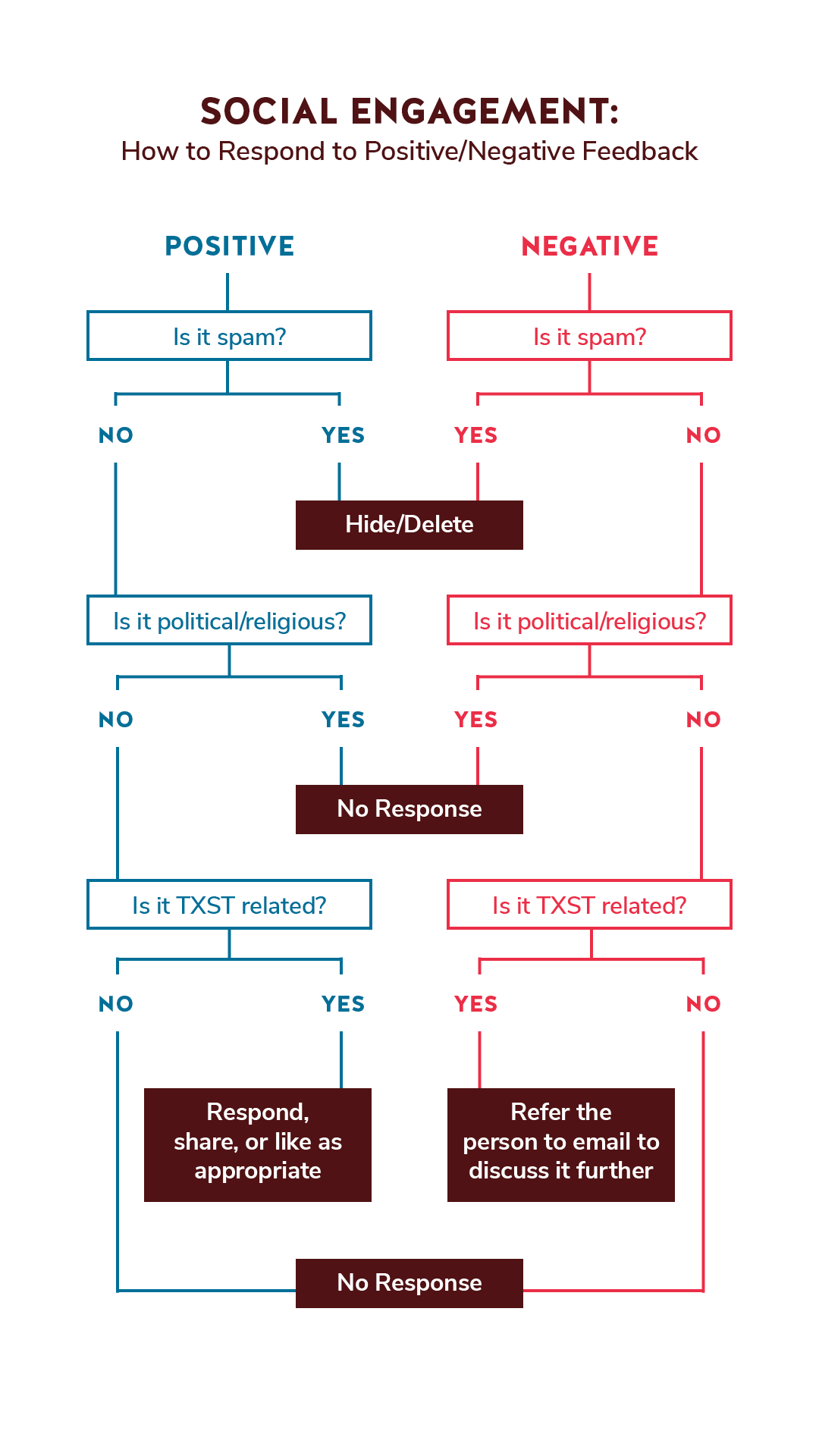
To maintain a good level of social engagement, there are some things to keep in mind about the kinds of posts you reply to or engage with. Most times, it is best to have no response unless it passes through other protective barriers.
Be sure to set your page moderation and profanity filters to 'strong' on all social platforms. The tools are built to hide or block obvious hate or vulgar message/comments but sometimes additional steps need to be taken: